
Search DeKalb County Civil Dockets
MyCase is the main online channel for public DeKalb County civil dockets. Search by cause number first. A party-name search works too, though you should select all DeKalb County courts when the division or case class is unclear. Before opening a result, match the court, the filing date, the party names, and the case code. Common names can pull up more than one case. The DeKalb County Clerk of the Circuit Court is the local fallback. Call the main and civil counter at (260) 925-0912, visit 100 S. Main Street in Auburn, or send the county copy-request form when you need a specific filing or a certified copy. Circuit Court's line is (260) 925-2764, and Superior Court II's line is (260) 925-5277. Treat MyCase as a reference display rather than the official record.
- Open MyCase and choose Case or Name.
- Select DeKalb County or enter the complete cause number.
- Confirm the civil case code and assigned court.
- Read parties, Events/CCS, hearings, orders, and judgment fields.
- Request an absent or certified filing from the clerk.
DeKalb Civil Cause Number Codes
DeKalb County civil dockets follow the numbering scheme set out in Indiana Administrative Rule 8. The official uniform case-numbering rule governs the county, court, filing-date, type, and sequence segments inside each cause number.
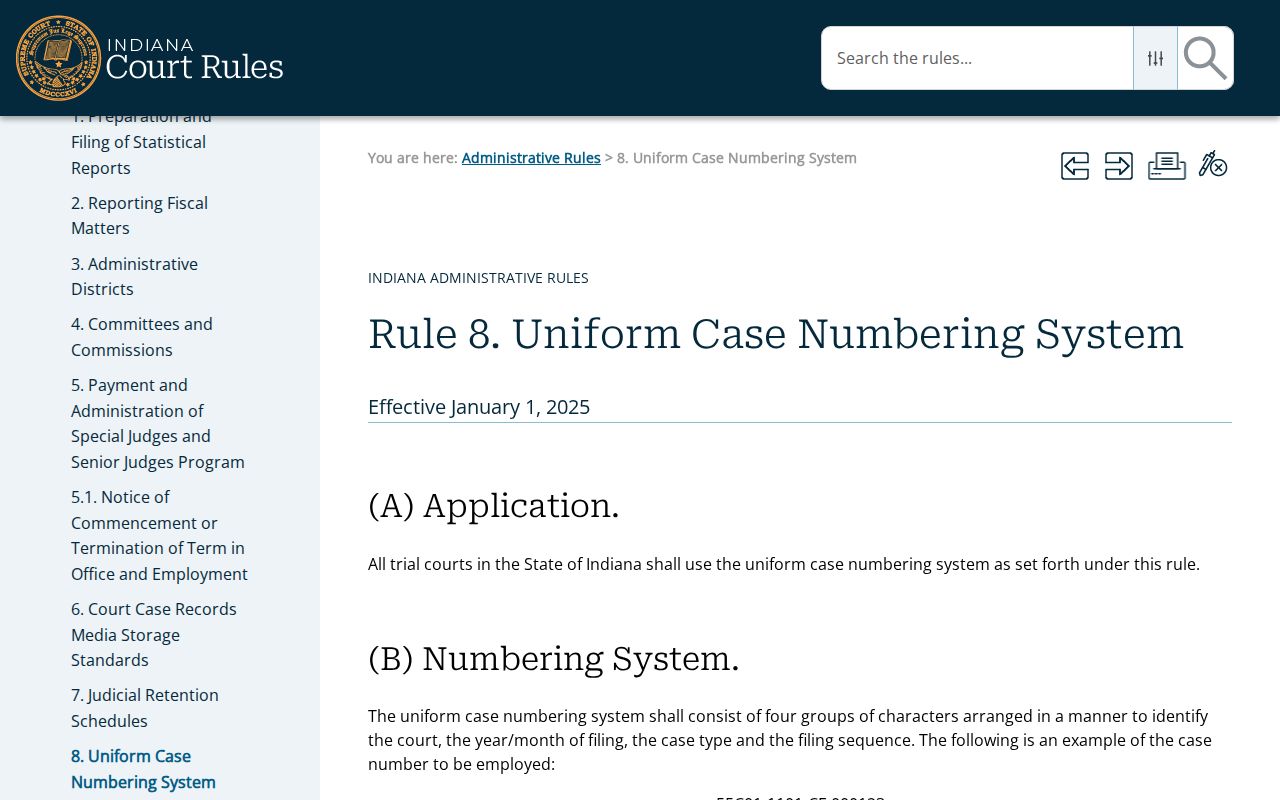
Take 17D02-YYMM-PL-###### as an example, which points to DeKalb Superior Court II and a civil plenary case. Circuit Court uses 17C01. Superior I uses 17D01. The YYMM segment gives the filing year and month, while older converted cases may carry legacy formatting and MyCase can pad the final sequence to six digits.
- PL
- Civil plenary, a broad civil case class.
- CT
- Civil tort.
- CC
- Civil collection.
- EV
- Eviction.
- MF
- Mortgage foreclosure.
- SC
- Small claim.
What a DeKalb Civil Docket Shows
A public civil case summary opens with case identity and then turns to history. Expect the cause number, court, filing date, case type, caption, status, parties, lawyers, dated Events/CCS entries, hearing sessions, available documents, judgments, financial fields, and appeal or transfer activity. The event list carries the real weight. A filed motion is only a request, a hearing is not a ruling, and an order may sit behind a separate linked document.
| Case Number | County, court, filing month, case type, and sequence. |
|---|---|
| Parties | Plaintiff and defendant, or petitioner and respondent where public. |
| Events/CCS | Dated complaints, answers, motions, orders, hearings, and notices. |
| Documents | Online files allowed by the public-document access matrix. |
| Judgment | Final result and possible amount, status, signed date, interest, or satisfaction fields. |
Financial fields never certify a current balance. For an official judgment balance, a satisfaction, or a certified record, ask the clerk.
Superior II Civil Allocation
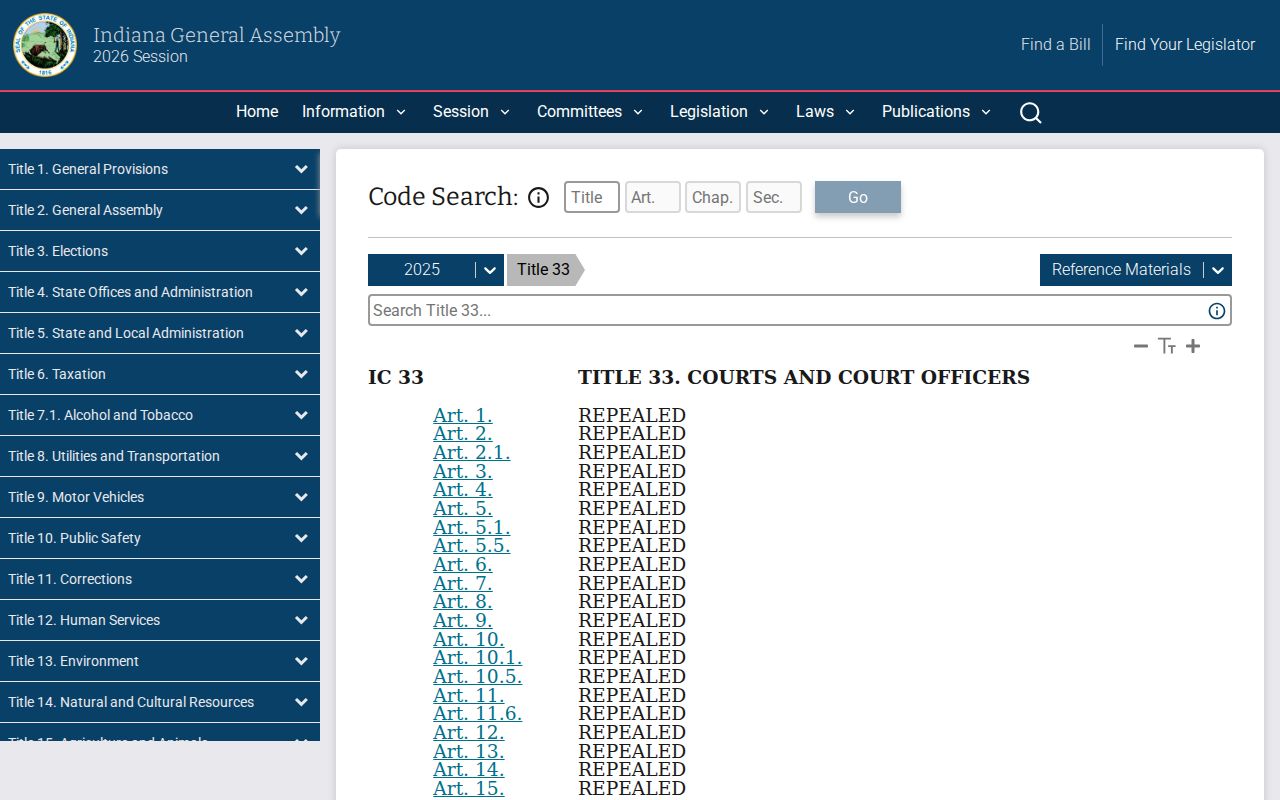
Under the current allocation plan, DeKalb Superior Court II is the exclusive local court for small claims, estates, trusts, infractions, civil plenary, mortgage foreclosure, civil tort, eviction, and civil collection cases. Other civil classes rotate. The Indiana Code Title 33 page lays out the broader statutory framework for the courts.
Some civil classes move between judges. Circuit and Superior II share domestic relations, mental health, adoption, unsupervised estates, guardianship, protection matters, tax proceedings, and many miscellaneous civil filings, subject to exceptions. Circuit Court keeps exclusive juvenile and certain support assignments. With only a party name in hand, the safest docket search still covers all DeKalb courts.
Types of DeKalb Civil Dockets
A case-type code names the filing class, nothing more. A PL case can include many forms of civil relief. An EV code marks an eviction case but says nothing about who prevailed. Civil collection matters can close by judgment, dismissal, settlement-related entry, or another order. Domestic, probate, protection, and juvenile filings also carry distinct access limits even when a public header exists.
- PL plenary, CT tort, and CC collection claims
- EV eviction and MF mortgage foreclosure cases
- SC small claims matters
- DN and DC domestic relations cases
- Probate, estate, trust, guardianship, and adoption matters
- Protection, tax, and miscellaneous civil proceedings
Let the code point you to the likely court, then let the current MyCase header settle the assignment. Local rotation and transfers can land a case in an unexpected division.
Read DeKalb Civil Events
DeKalb civil dockets pack a lot of meaning into short labels. APP records an appearance, and ANS marks an answer. M is a motion, while ORD means an order was issued. HPTC is a pretrial conference, HSJU is a hearing on summary judgment, MTC records a motion for continuance, FJ marks final judgment, and NAPP identifies a notice of appeal. Read these labels in sequence rather than alone.
| Entry | Plain meaning | Next check |
|---|---|---|
| M or MHRG | A motion or hearing request was filed | Response, hearing, and ruling |
| HSACT or HPTC | Scheduling or pretrial activity | Latest session date |
| ORD or HJE | Order or hearing journal entry | Linked document and later events |
| FJ | Final judgment entry | Appeal or satisfaction activity |
A CONV label marks an item imported from an earlier system. It is not a new filing. DeKalb's Odyssey transition occurred in 2008, so older records may keep events that have no online PDF files.
Settings on DeKalb Civil Dockets
DeKalb County publishes no separate case-calendar search covering all civil matters. Hearing events inside each MyCase record serve as the practical public calendar. Check the event date, start time, court, judicial officer, session description, and current status. HSACT, HPTC, OHRG, MHRG, HJE, and HSJU can point to a setting, but later entries may reset or cancel it. One scheduling order can set several deadlines at once. A motion for continuance does not prove the date moved; find the order granting or denying it, then check the newest hearing block. If a date is close or two entries conflict, call the assigned court. The broader DeKalb County court calendar workflow explains how to verify a setting. Note: When portal entries look unclear, the newest signed order and confirmation from the assigned court control.
DeKalb Civil Caseload Context
The Indiana Trial Court Statistics application filters by county, court, report, and year rather than case-level records.
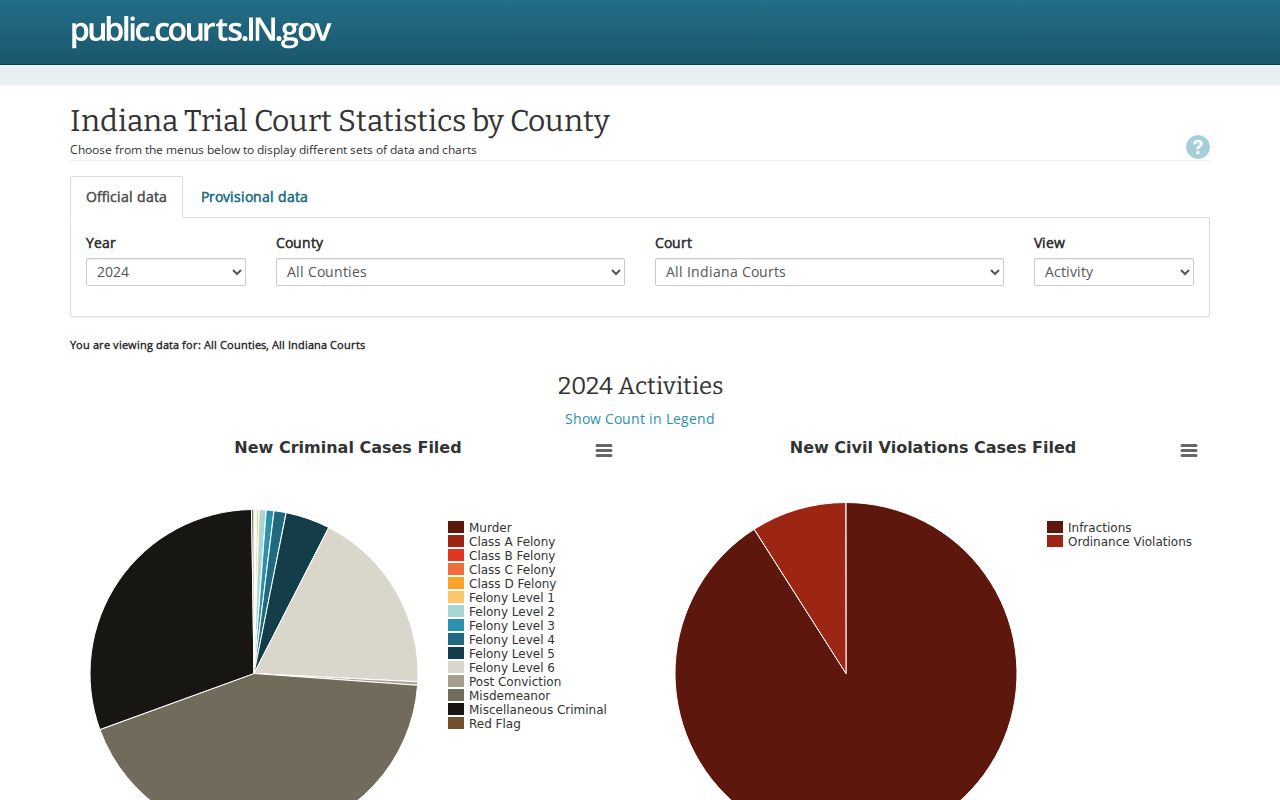
DeKalb County's courts carried a heavy load in 2024. The all-court display showed 8,519 new filings and 16,150 matters already pending, for 24,740 total cases before the courts. One caution: those totals pull from criminal, civil, juvenile, infraction, and other tables at once. They are not civil-only numbers. Caseload figures describe the workload of the whole court system, while MyCase is the tool that finds one DeKalb County civil docket. The official statistics hub keeps current provisional figures separate from the older reporting tools, which keeps any caseload claim anchored to the year it covers.
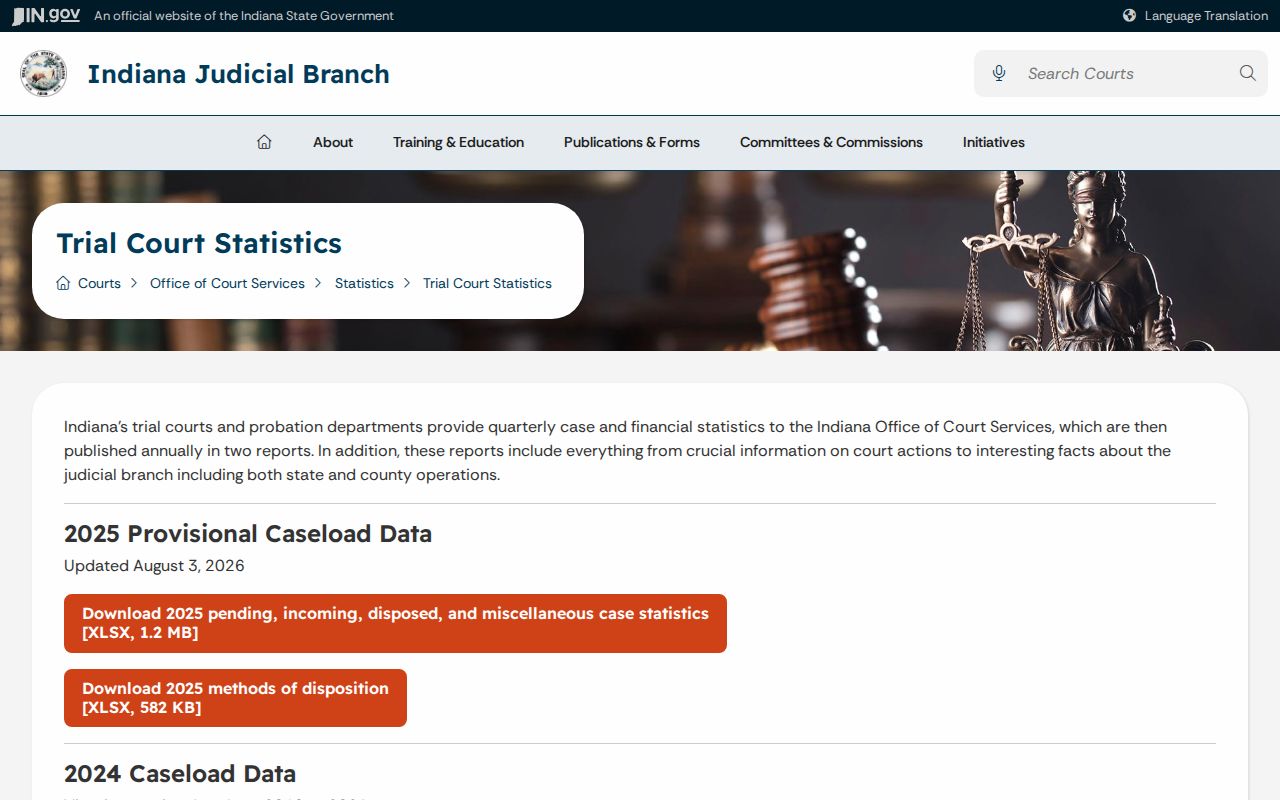
That separation matters. It keeps a caseload number tied to its year and chart instead of turning aggregate filings into something they are not: a searchable index of parties.
Public Access to DeKalb Civil Dockets
Indiana Access Rule 4 starts from openness. Most court records are public unless Rule 5 or another authority excludes them. The excluded list covers sealed cases. It also covers mental-health proceedings, juvenile and paternity material, protection matters, and confidential medical or financial attachments. Anything a court has ordered withheld stays off the list too. Even then, a case can stay public while one filing inside it does not. So the case header and event register may show more than the online documents do.
Key Rules:
Access Rule 4 states the general public-access presumption.
Access Rule 5 defines excluded records and protected categories.
Access Rule 9 governs extraordinary verified requests for excluded material.
The Indiana Judicial Branch explains this reporting context on its trial-statistics help page, which spells out the difference between official and provisional years.
Aggregate numbers never unlock a sealed civil filing. When a document is missing, note the case and event, check the public-document matrix, and ask the clerk. It may be available in person, too old for online display, or excluded from view.
Find a DeKalb Civil Order
Work from the Events/CCS list on a DeKalb County court docket. Start with the filing date and its event label. A motion often draws a response, a hearing, a journal entry, and a final order. Watch for the codes ORD, HJE, and FJ. See whether MyCase attaches a document link. Even when an older converted case shows a null document field, the docket line still proves the filing or ruling was entered.
For the paper itself, contact the DeKalb County Clerk. Give the clerk the cause number, the event name, and the date. Say whether a plain or certified copy is needed. The current clerk form lists per-page and certification charges. The clerk, not an online judgment field, supplies the official copy and the current financial statement. Cases touched by the 1913 courthouse fire or a later conversion may call for an older index or archive search. A modern PDF may not exist for them.
The county copy form asks for more than the cause number. Party names, document type, filing or order date, copy count, requester contact details, and certification needs all go on it. A self-addressed stamped envelope helps if you want the copies mailed back. The published form states a $1 per-page copy charge and a $3 per-document certification charge. Card convenience terms sit separate. Confirm the quoted amount when you place the request.
A civil judgment can create docket work long after entry. Satisfaction, interest, appeal, transcript-completion, and clerk events may follow the final judgment. When the current status of a judgment matters, read past the FJ line. Online financial fields describe categories in the system. The clerk supplies the official balance or satisfaction record.
Verify DeKalb Civil Docket Details
Begin any DeKalb County civil docket check with the court, the DeKalb cause number, and the civil case code. Match the parties and filing date. Then read the docket in order. A motion is a request, not a ruling. A hearing entry is not a final judgment.
For a scheduled setting, compare the event date, time, judge, and court. A later continuance or scheduling order can push aside an earlier date, and two conflicting events call for a quick call to the assigned DeKalb court. Superior II handles many DeKalb civil classes; Circuit takes other assignments.
A copy request should name the cause number, the parties, the filing or order, and the event date. State up front whether the civil record must be certified. The clerk's current form governs copy charges and payment terms. Keep in mind that a MyCase image is not a certified DeKalb court record.
Older civil docket work may show a Converted Event with no linked document. Ask the clerk whether the filing exists on paper or at the counter. Sealed, family, juvenile, mental-health, protection, and confidential material stays subject to Indiana access rules.
DeKalb Civil Record Match
Close out the DeKalb civil check by matching the court, cause number, parties, case code, and newest order. For a judgment with money involved, one more step: ask the DeKalb clerk to confirm the balance and any satisfaction entry.
DeKalb Civil Docket Confirmation
Keep the final DeKalb result with the assigned court.